Khachkar
(Armenian cross-stone)
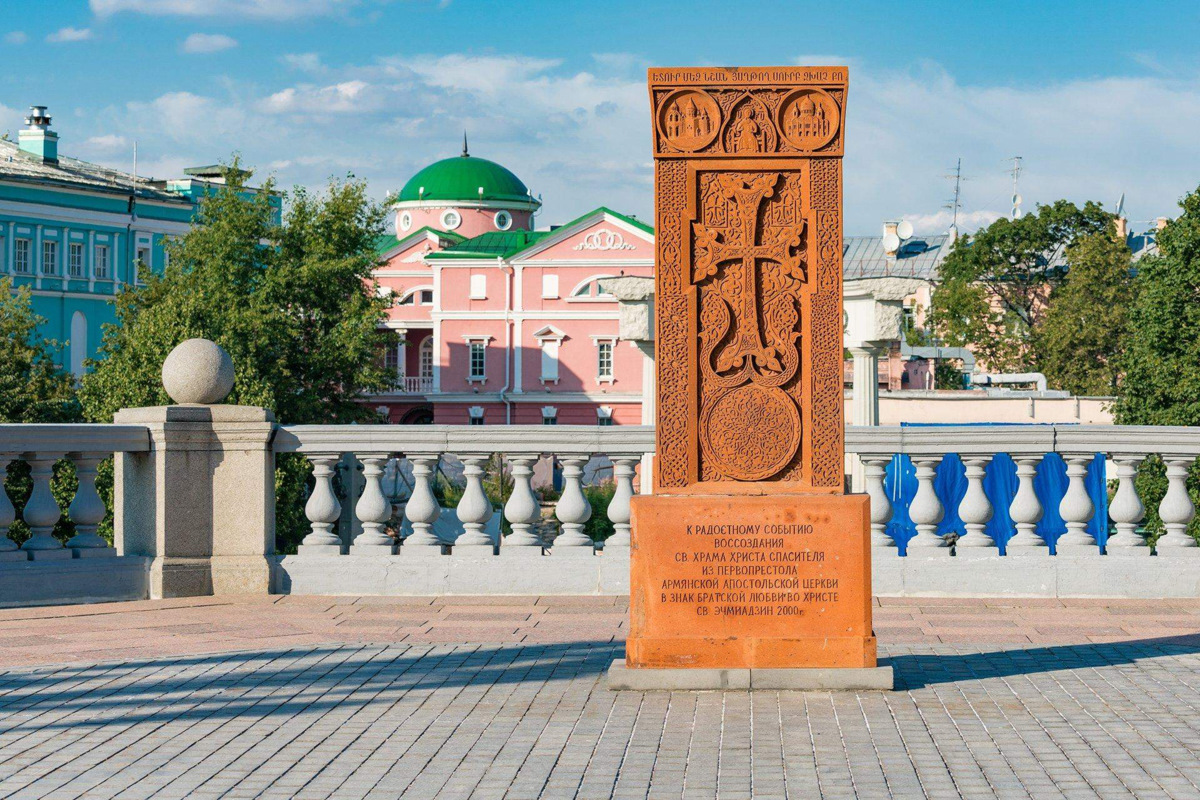
A khatchkar is located near the Cathedral of Christ the Saviour in Moscow. Khatchkars are well-known throughout the world. Translated from Armenian, “khatchkar” means “cross-stone.” It is an ancient form of Armenian architectural monument, a stone stela with a carved image of a cross. Each monument is distinguished by its unique pattern. On each one, one can see a kind of splendid stone lacework, within which rests a richly ornamented cross. Yet, at the same time, all the patterns are executed in a unified style. Khatchkars are imbued with a unique Armenian spirit, which makes them akin and easily recognizable. Like living witnesses of the centuries, they have absorbed the entire history of Christian Armenia over 1700 years. It should be noted that the creation of khatchkars is a distinctive feature specifically of Armenian culture. This art form is not mastered by anyone else in the world. The entire territory of historical Armenia has long been strewn with these masterpieces of talented Armenian hands. In our time, Armenian khatchkars can be found at the headquarters of the United Nations, in the parliaments of several countries, and in some of the world’s largest museums. These are gifts from Armenia to friendly states. Priceless ancient khatchkars are usually displayed in the most prominent places.The khatchkar made of orange tuff was presented in 2000 by His Holiness Karekin II, Supreme Patriarch and Catholicos of All Armenians, in honor of the rebuilding of the Cathedral of Christ the Saviour, as stated in the inscription on the monument. The opening ceremony was attended by His Holiness Alexy II, Patriarch of Moscow and All Russia, and His Holiness Karekin II, Supreme Patriarch and Catholicos of All Armenians.
Address: Moscow