Monument
“Reunification”
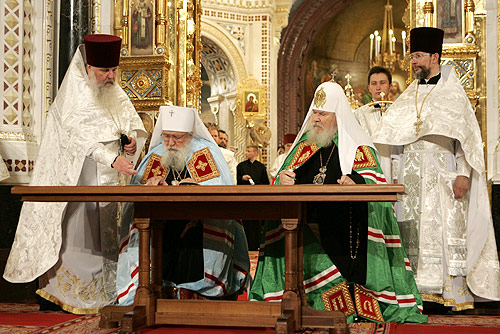
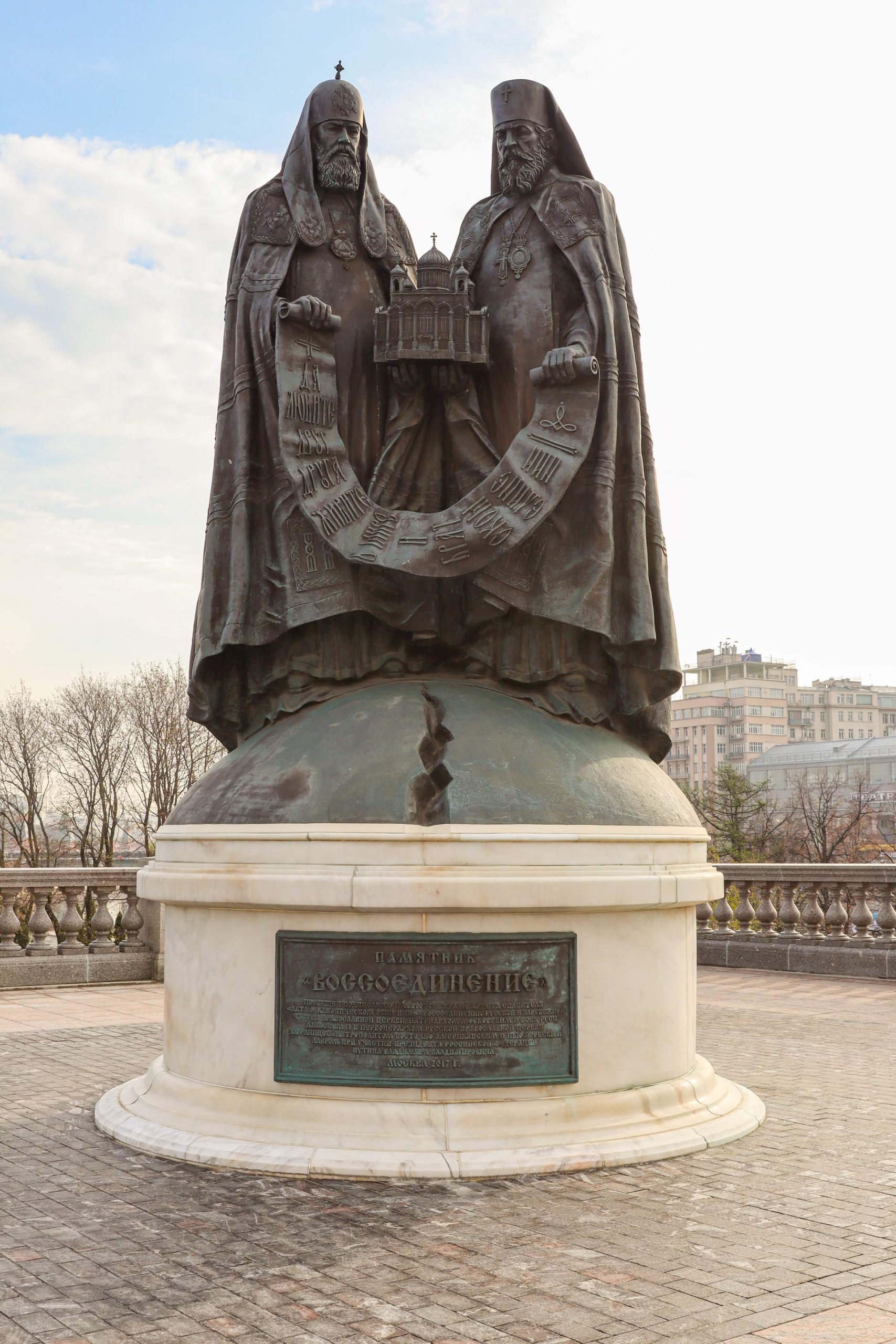
On the eastern stylobate of the Cathedral of Christ the Saviour, at the very base of its white stone walls, a moment that changed the fate of millions of believers stands frozen in bronze. The sculptural composition “Reunification” is not merely a monument to an event, but a symbolic overcoming of historical trauma: the schism that lasted nearly eight decades, and the return to unity lost during the years of revolutions and exile. On May 17, 2007, within the walls of the rebuilt cathedral-whose own resurrection from the ruins symbolized the revival of national memory-the Act of Canonical Communion was signed. The Moscow Patriarchate and the Russian Orthodox Church Outside of Russia, divided by the tragedy of the 20th century, once again found ecclesiastical unity. Ten years later, on June 18, 2017, this reconciliation took material form-a sculptural composition embodying the pain of separation and the joy of return. The creators of the monument-architect Goran Dragicevic and sculptors Pavel Zhuravlev and Alexander Nozdrin-chose a language at once simple and multi-layered. Upon a fractured globe, whose cracks speak of history’s ruptures, stand two hierarchs: Patriarch Alexy II of Moscow and All Russia, and Metropolitan Laurus (of Eastern America and New York), First Hierarch of the Russian Church Abroad. Their figures face each other not with a gesture of triumph, but with one of humility and gratitude. In their hands are not symbols of power, but symbols of a shared heritage: a miniature model of the Cathedral of Christ the Saviour, rebuilt at the end of the 20th century as a sign of reconciliation with the past, and the very Act of Canonical Communion itself-the document that sealed spiritual unity. The fracture beneath their feet is neither hidden nor filled: it is acknowledged, accepted, overcome. This is not a monument to victory, but a memorial to healing. The placement of the composition is no coincidence. The eastern stylobate of the cathedral-a point facing Moscow’s historic center, toward the Kremlin, toward the river carrying waters through the centuries. Here, against the walls of a cathedral that became a symbol of Russia’s rebirth after the atheist era, another reunification finds its meaning-not only ecclesiastical, but national, cultural, historical. “Reunification” does not shout. It speaks in bronze silence, within which echoes can be heard: the prayers of émigrés in foreign lands, the grief of mothers who sent their sons into exile, and the quiet hope of those who believed the schism would not last forever. The monument reminds us that unity is not a given, but a gift requiring careful tending. And that the deepest wounds of history sometimes heal-not by being forgotten, but by being transformed into strength. Today, passing by this sculpture, visitors to the cathedral involuntarily slow their pace. Before them stand not merely bronze figures. Before them is a dialogue across time and space, frozen in metal. A dialogue that once found its continuation.
Address: Moscow