Andrei Dmitrievich
Sakharov
1921-1989

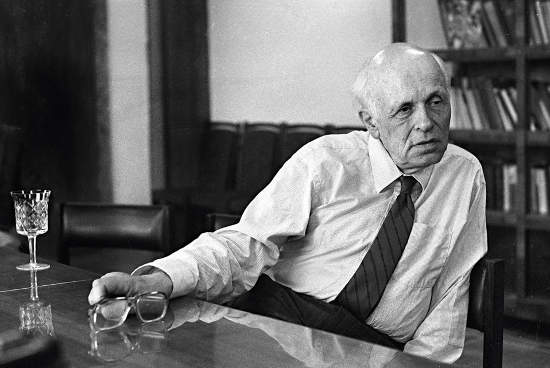
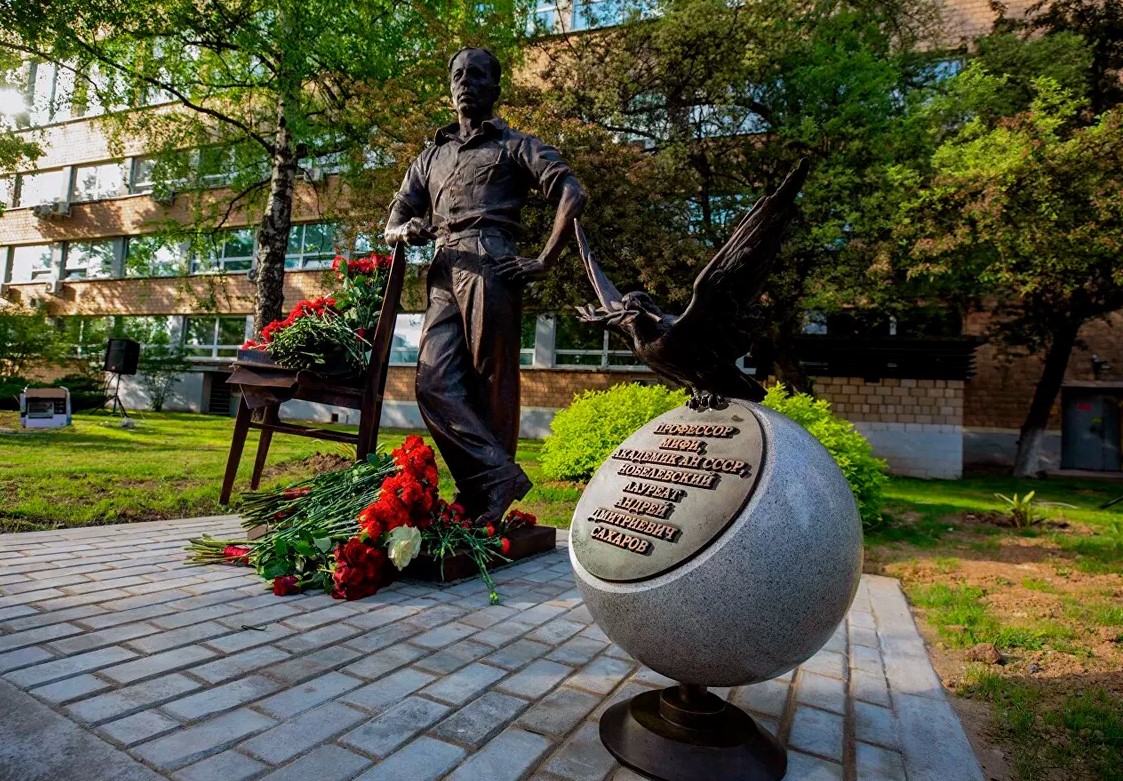
Andrei Dmitrievich Sakharov was a Soviet theoretical physicist, Academician of the USSR Academy of Sciences, and one of the creators of the first Soviet hydrogen bomb. He was also a public figure, human rights activist, and recipient of the Nobel Peace Prize (1975). He was born on May 21, 1921, in Moscow. In 1938, he entered the Physics Department of Moscow State University. In 1941, due to the university’s evacuation, he completed his studies in Ashgabat, after which he was assigned to a military factory in Kazan, working as an engineer. In 1945, he began postgraduate studies at the Lebedev Physical Institute (FIAN) of the USSR Academy of Sciences under Academician I.E. Tamm, specializing in theoretical physics. In 1948, he was recruited to work on thermonuclear weapons as part of a special research group. He made a decisive contribution to the creation of the first Soviet hydrogen bomb, the RDS-6s, tested in 1953. Concurrently in 1950, together with I.E. Tamm, he proposed the fundamental scheme for magnetic plasma confinement to achieve controlled thermonuclear fusion, known as the “tokamak.” For his work on defense-related topics, he was three times awarded the title of Hero of Socialist Labor (1953, 1956, 1962) and became a laureate of the Stalin Prize (1953) and the Lenin Prize (1956). In 1953, he was elected a corresponding member, and in 1962, a full member of the USSR Academy of Sciences. From the second half of the 1950s, he actively campaigned against nuclear testing in the atmosphere. He authored fundamental works on cosmology, gravitation theory, and elementary particle physics.
Address: Moscow, Kashirskoe shosse, 31