Monument to
Alexander II
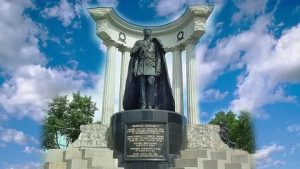
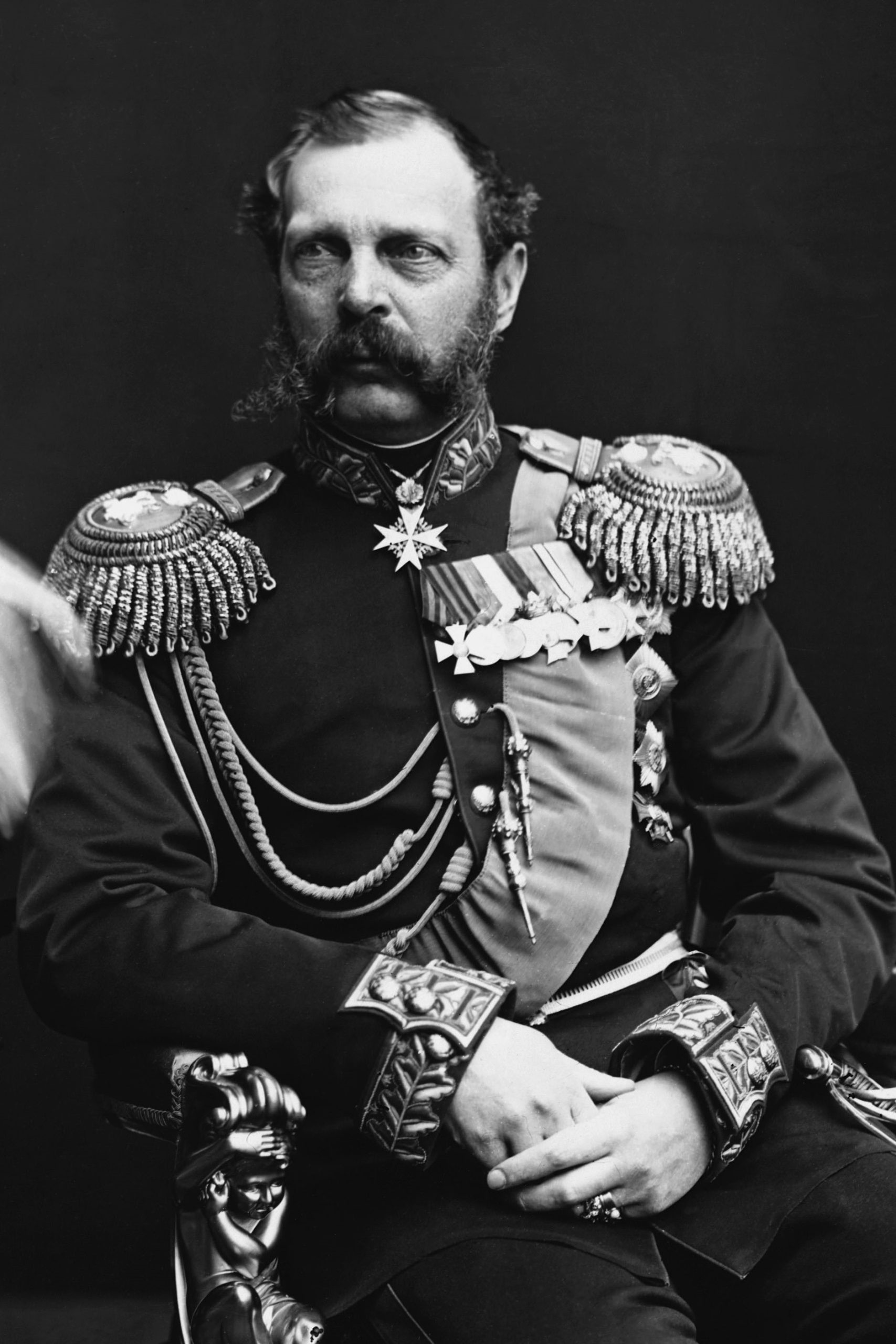
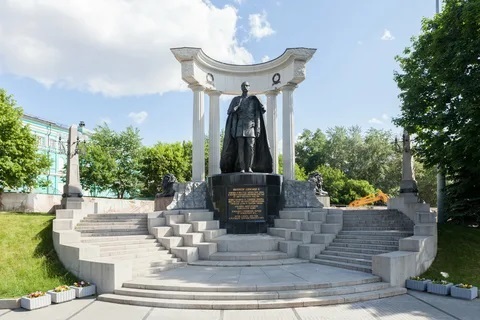
On June 7, 2005, a monument to Emperor Alexander II (1818 – 1881) was unveiled in Moscow, in the square between Volkhonka Street, Vsesvyatsky Proyezd, and Prechistenskaya Embankment, near the altar part of the Cathedral of Christ the Saviour. Its authors are sculptor Alexander Rukavishnikov, architect Igor Voskresensky, and artist Sergey Sharov. The location was chosen for a reason: it was during Alexander II’s reign that the cathedral was founded, and the greater part of it was constructed under him; the monument was erected as a symbol of this historical continuity. The monumental ensemble is integrated into the landscape of the circular square, becoming its dominant feature. It combines sculpture with architectural elements: a landscaped slope, concentric flower beds, deciduous trees, a decorative pool with a fountain, tiled pathways, benches, and stylized lanterns. The monument was deliberately placed in a hollow, below the level of the cathedral square. This positioning provides an excellent view from the observation platform behind the balustrade, enhancing the perception of the cathedral’s grandeur. The full-length figure of Alexander II stands erect, with his left knee slightly bent, his arms at his sides, and his gaze directed towards the cathedral. He wears a military uniform adorned with orders, a dress sword, and a long mantle embroidered with double-headed eagles, its train sweeping the ground – a testament to his royal dignity. The absence of a crown on his head allows the pose to be interpreted as a spiritual coronation before the altar. The cylindrical pedestal is made of three-meter-high polished black granite, surrounded by stepped stone blocks. On it, in regal lettering, are inscribed his key reforms: the abolition of serfdom in 1861, liberating millions of peasants; military and judicial reforms; the establishment of local self-government (zemstvos); the completion of the Caucasian War; assistance to Slavic peoples against the Ottoman Empire; and his death in a terrorist attack on March 1 (13), 1881. Behind the figure stands a curved bronze rotunda on a semicircular base, featuring Doric columns without capitals that echo the architecture of the cathedral. On either side are realistic lions on granite pedestals, each distinguished by its snarl, head turn, and musculature; they symbolize strength, dignity, and tradition. Flanking the colonnade are two Egyptian-style obelisks topped with cast-iron retro lanterns, their bases adorned with black granite cannonballs. When viewed through the arches of the colonnade, the contours of the emperor’s head and mantle harmonize remarkably with the line of the cathedral’s domes. Even the train of his mantle, seemingly vibrating in the wind, creates the illusion of a solemn stride. The monument to Alexander II near the Cathedral of Christ the Saviour is more than just a tribute to history. It is a rare example of spatial thinking in urban sculpture, where every element, from the lions to the lanterns, serves a unified idea: the idea of a path. A path that leads the Tsar Liberator to the cathedral, and with him, invites each of us to reflect on the destiny of Russia.
Address: Moscow